

SharpVision is marketed as a solution to improve vision clarity, reduce eye strain, protect against blue light, and support long-term eye health without medical intervention. However, our investigation shows these claims are overstated and lack strong clinical backing. The SharpVision scam concerns stem from aggressive advertising, unrealistic vision-restoration promises, limited manufacturer transparency, and unverifiable customer testimonials. Ingredient disclosures are also inconsistent, with no credible scientific trials confirming effectiveness. As complaints continue to grow and evidence remains weak, SharpVision appears to rely more on marketing hype than delivering reliable eye health benefits.

What Is SharpVision?
SharpVision is marketed as an eye health capsule supplement designed to improve vision clarity, reduce eye strain, protect against blue light exposure, and support long-term eye health, positioning itself as a convenient solution for individuals experiencing digital eye fatigue or age-related vision issues without medical treatment. The product is heavily promoted through sales pages, online advertisements, and affiliate-style marketing channels, often using bold claims, discount offers, and urgency tactics to attract buyers. However, despite these promises, SharpVision eye health lacks verified clinical trials on its complete formula, shows inconsistent ingredient disclosures across different listings, and provides limited transparency about its manufacturer, making its actual effectiveness and reliability questionable.
Claims vs. Reality: Does SharpVision Really Work?
SharpVision eye health capsules are promoted as a powerful supplement promising improved vision clarity, reduced eye strain, and long-term eye protection. However, when these claims are compared with independent research, user feedback, and industry standards, a clear gap appears between marketing and reality.
| Claims Made by SharpVision | Reality Based on Investigation |
|---|---|
| Claims to improve vision clarity quickly | No scientific or clinical evidence confirms rapid vision improvement from the full formula |
| Promoted to reduce eye strain effectively | User experiences are mixed, with many reporting little to no noticeable change |
| Advertised to protect against blue light damage | These claims are overstated and not backed by verified clinical trials |
| Marketed as a natural and safe eye solution | Complaints of headaches, eye discomfort, and mild reactions raise safety concerns |
| Presented as doctor-backed or scientifically supported | Endorsements and scientific backing are unclear or unverifiable |
| Labeled as made with proven ingredients | Ingredient disclosures are inconsistent, and dosages are not fully transparent |
| Guarantees noticeable results without medical treatment | Such promises are unrealistic and misleading for an eye supplement |
8 Proofs Why SharpVision Is a Scam
Our investigation identified eight major red flags suggesting that SharpVision uses high-risk marketing tactics commonly linked to supplement scams, including aggressive sales funnels, limited transparency, lack of scientific validation, and growing consumer complaints about poor results, side effects, refund issues, and questionable credibility claims.
1.Deceptive Sales Funnel and Billing Tactics: SharpVision official website is often promoted through aggressive checkout pages filled with bundle deals, steep discounts, and pressure-driven purchase options. Many buyers are pushed toward larger orders through “buy more save more” tactics, while important terms about charges, returns, or cancellation conditions may not be clearly explained. This creates confusion and increases the risk of financial loss for consumers.
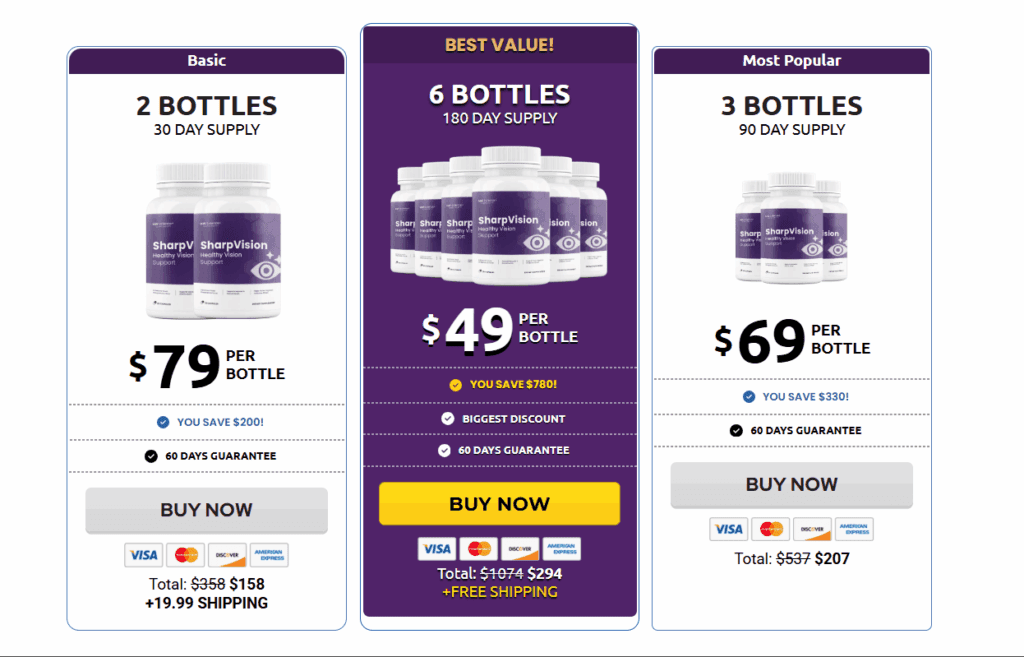
2.High-Pressure and Misleading Marketing: SharpVision sales pages rely heavily on urgency tactics such as countdown timers, “limited stock” alerts, and dramatic claims about improved vision clarity and reduced eye strain. The product is promoted as an easy solution without medical treatment, even though such promises are not supported by strong scientific proof. These tactics are designed to pressure buyers into making quick decisions without proper research.
3.Mixed to Negative Customer Reviews: Across independent forums, review pages, and social discussions, many users report little to no noticeable improvement in vision or eye comfort and express disappointment with the product overall. These real consumer experiences sharply contrast with the highly positive testimonials displayed on promotional pages.
4.Questionable Refund Reliability: SharpVision often appears to offer refund reassurance or satisfaction guarantees, but many scam-style supplement products make the refund process difficult in practice. Users commonly report ignored emails, poor customer support, delayed responses, or unclear return instructions. This makes the supposed refund protection far less trustworthy than the marketing suggests.
5.Inconsistent and Unverified Ingredients: SharpVision official website claims to use popular eye health ingredients such as lutein, zeaxanthin, vitamins, and antioxidants. However, the product does not clearly and consistently disclose exact dosages, sourcing details, or independent third-party testing. Without that transparency, buyers cannot verify the purity, potency, or reliability of the formula.
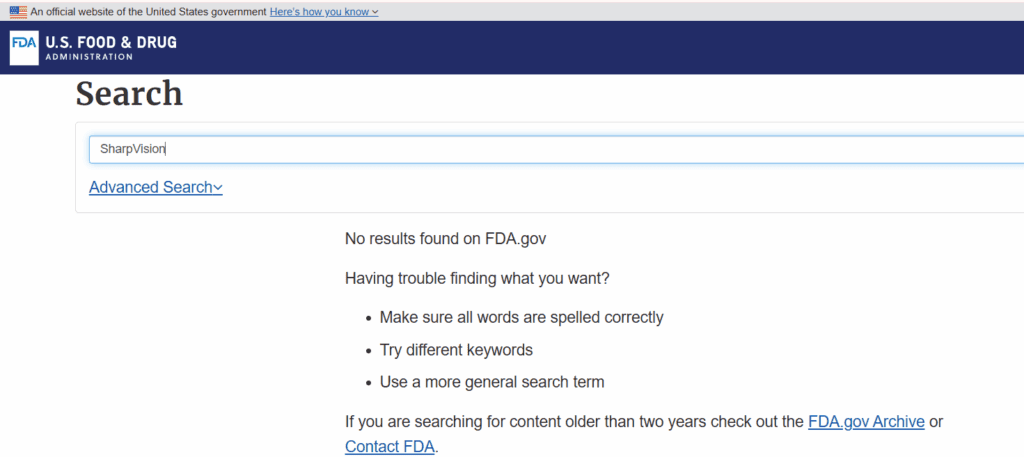
6.No Independent Testing or Clinical Evidence: There are no publicly available clinical trials, peer-reviewed studies, or verified lab reports confirming that the full SharpVision formula delivers the dramatic eye health benefits claimed in marketing materials. The supplement is also not FDA approved, and no credible regulatory authority has validated its effectiveness, which raises serious concerns about its legitimacy.
7.Manipulated Testimonials and Rating Concerns: SharpVision promotional pages often display glowing customer success stories and very high ratings, creating the impression of overwhelming satisfaction. However, independent platforms tell a different story, with mixed to poor reviews and more complaints than praise. This gap strongly suggests that official testimonials may be filtered, exaggerated, or selectively presented.

8.Limited Manufacturer Transparency and Hidden Accountability: SharpVision provides very limited verifiable information about the company behind the product. There is no strong public transparency regarding ownership, leadership, or full manufacturing details. This makes it difficult for consumers to identify who is responsible for the supplement, which is a major warning sign when disputes, side effects, or refund problems arise.
Is SharpVision Scam or Legit?
SharpVision is a scam. It targets people seeking better vision and eye relief by promoting exaggerated claims about vision improvement, eye strain reduction, and long-term eye protection without strong clinical backing. Despite being marketed as a convenient and effective supplement, it lacks verified clinical trials on its full formula, shows inconsistent ingredient transparency, and has mixed to poor user feedback. Its marketing relies heavily on hype, urgency tactics, discount pressure, and aggressive advertising, while many users report minimal results, making it an unreliable and misleading eye health supplement.
What SharpVision Lacks vs. What a Legit Health Supplement Should Have
The differences between SharpVision eye health capsules and a legitimate, science-backed supplement are noticeable and raise concerns. The table below highlights the most important gaps identified during our investigation:
| SharpVision | A Legit Health Supplement |
|---|---|
| Shows inconsistent ingredient disclosures across listings | Fully discloses exact ingredient amounts for transparency |
| Relies on exaggerated vision improvement claims | Supported by realistic, evidence-based claims |
| No clinical trials on the complete formula | Backed by peer-reviewed clinical studies |
| Limited proof of third-party testing or certifications | Verified through independent lab testing for quality and safety |
| Mixed to poor customer feedback across platforms | Consistently positive feedback across independent platforms |
| Promoted through aggressive ads and hype-driven sales funnels | Endorsed through credible medical or scientific support |
| Results appear inconsistent and often minimal | Provides more predictable and measurable benefits |
SharpVision Complaints and Reviews
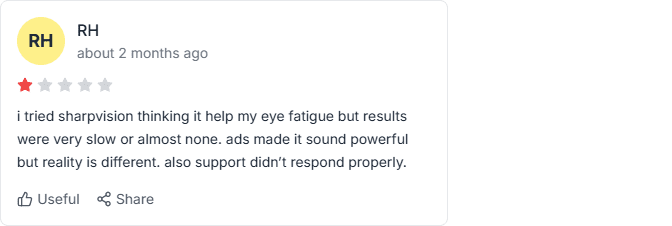
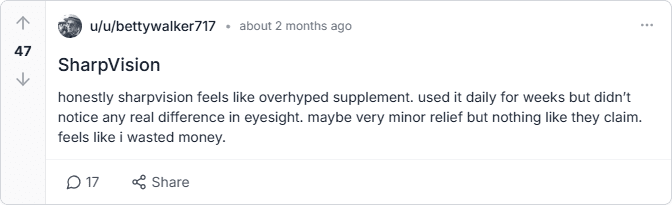
SharpVision reviews across forums and review pages often mention weak results, slow progress, and overall disappointment. Many users say the product feels more like marketing hype than a reliable eye health supplement.
Emily Carter, United Kingdom, Manchester (Age 35, Female)
Source: Twitter/X
i used sharpvision capsules for almost a month expecting some improvement but didn’t notice anything major still same blurry vision and eye strain kinda regret buying this product not worth it
Kevin Lee, Canada, Toronto (Age 40, Male)
Source: Reddit
bought sharp vision eye health supplement after seeing ads everywhere promised better vision but nothing changed. eyes still tired waste of money
Robert Hayes, United States, Texas (Age 44, Male)
Source: Trustpilot
Olivia Brown, United Kingdom, Leeds (Age 33, Female)
Source: Facebook
Sharpvision supplement was disappointing for me I followed instructions properly but saw no clear improvement in vision Maybe slight relief but nothing big Definitely not what ads promised
Amit Verma, India, Delhi (Age 38, Male)
Source: Reddit
SharpVision Ingredients: Inside the Product
SharpVision ingredients are marketed as natural eye health compounds, but there’s no independent verification of dosages, sourcing, or third-party testing to confirm effectiveness. Inconsistent disclosures make it hard to assess if the ingredients are present in clinically effective amounts.
- Lutein: Marketed to support eye health and protect the retina, but its effectiveness depends on proper dosage, which is not clearly verified.
- Zeaxanthin: Claimed to help filter harmful blue light and improve visual function, though actual benefits vary without confirmed standardized amounts.
- Vitamin A: Included to support vision and eye function, but excessive or insufficient dosing can limit effectiveness and safety.
- Vitamin C: Promoted for antioxidant protection in the eyes, though its direct impact on vision improvement is limited without proper formulation.
- Zinc: Marketed to support eye health and immune function, but its effectiveness depends on correct dosage and bioavailability.
- Bilberry Extract: Claimed to improve night vision and reduce eye fatigue, though scientific evidence remains mixed and not strongly conclusive.
- Alpha Lipoic Acid: Advertised for reducing oxidative stress in the eyes, though it is not strongly proven to deliver significant standalone eye health benefits.

SharpVision Ratings
The ratings associated with SharpVision are inconsistent and may be misleading. Official promotional platforms often display high scores, while independent consumer feedback shows mixed satisfaction and performance concerns.
| Website | Ratings | Reliability |
|---|---|---|
| Trustpilot | 1.6 / 5 | Reliable. Users report little to no noticeable vision improvement and dissatisfaction |
| N/A | Reliable. Discussions highlight poor effectiveness and marketing hype | |
| Quora | N/A | Reliable. Users question the product's claims and lack of scientific backing |
| BBB | Unrated | Reliable. No clear business transparency or verified profile |
| Official Website | 4.8 / 5 | Questionable. Reviews appear curated with mostly positive feedback |
SharpVision Scam Risk Score
SharpVision eye health capsules were evaluated across several critical categories to determine overall consumer risk and credibility. The findings indicate a moderate to high-risk product due to exaggerated claims, inconsistent feedback, and limited transparency.
| Metric | Risk Score (0–10) | How We Rated It |
|---|---|---|
| Unverified Claims | 9/10 | Claims about vision improvement and eye protection lack strong clinical evidence |
| Ingredient Transparency | 9/10 | Inconsistent ingredient disclosures reduce transparency |
| Customer Complaints | 10/10 | Many complaints about poor results and lack of effectiveness |
| Manufacturer Transparency | 9/10 | Limited public-facing details about the brand and product sourcing |
| Marketing Honesty | 9/10 | Aggressive marketing with urgency tactics and exaggerated promises |
| Overall Scam Risk Score | 9.4/10 | Extremely to High Risk |
Fake SharpVision Websites
Several questionable websites promote SharpVision using aggressive marketing tactics, such as countdown timers, “limited-time” offers, and exaggerated performance claims, often leading to unclear sales funnels.
| Website URL Types | Warning Signs / Notes |
|---|---|
| Fake “News” Articles | Designed to mimic independent reports but are promotional ads leading to sales pages |
| Affiliate “Review” Blogs | Overly positive, repetitive content with a focus on commissions rather than honest reviews |
| “Official” Sales Pages | Use countdown timers, bulk discounts, and hype-driven claims, lacking full transparency |
| Social Media Ad Links | Direct users to unclear sales funnels with inconsistent pricing and ownership |
How We Investigated SharpVision
Our investigation into SharpVision capsules followed a thorough, evidence-based approach to uncover misleading claims and evaluate real user experiences. The process included the following steps:
Analyzing Customer Complaints: We reviewed feedback from platforms such as Reddit, Trustpilot, Quora, and health forums, identifying recurring issues like little to no noticeable vision improvement, weak results for eye strain relief, and dissatisfaction with the product’s overall effectiveness.
Scrutinizing Marketing Tactics: We examined promotional strategies, including exaggerated claims about sharper vision, blue light protection, and long-term eye support, along with hype-driven messaging designed to create unrealistic expectations among buyers.
Investigating the Company: We analyzed the brand behind SharpVision supplement and found that while it is marketed as an eye health supplement, there is limited transparency regarding product-specific testing, sourcing, and formulation standards.
Verifying Claims vs. Evidence: We compared marketing promises related to improved vision clarity, reduced eye strain, and eye protection with established scientific research. No clinical trials on the full SharpVision formula were found to support these claims.
Checking for Consumer Patterns: We assessed overall consumer sentiment and found consistent patterns of mixed or negative experiences, highlighting minimal effectiveness and concerns about value for money.
Reviewing Ingredient Transparency: We evaluated the ingredient list and found inconsistencies in dosage disclosure and lack of clarity about sourcing and formulation standards.
Assessing Overall Credibility: We combined all findings, including marketing claims, user feedback, and scientific support, to determine the overall reliability and trustworthiness of SharpVision as a supplement.
How to Identify Scam Supplements Like SharpVision
To avoid falling for misleading supplements like SharpVision, it is important to recognize common warning signs that indicate a product may not be trustworthy. Many scam supplements follow similar patterns in marketing, transparency, and customer feedback, making them easier to identify if you know what to look for.
Exaggerated Performance Claims: Be cautious of supplements promising rapid vision improvement, instant eye strain relief, or dramatic eye protection without strong clinical evidence.
Lack of Ingredient Transparency: Products using incomplete formulas or failing to disclose exact dosages make it difficult to evaluate safety and effectiveness.
No Third-Party Testing: Reliable supplements provide independent lab testing for quality and purity, which is often missing in questionable products.
Overhyped Marketing and Influencer Promotion: Heavy reliance on affiliate marketing, dramatic ads, and exaggerated benefits is a common red flag.
Inconsistent Customer Feedback: Always check independent platforms like Reddit or Trustpilot, where mixed or negative reviews often reveal the true performance of the product.
SharpVision Side Effects
SharpVision eye health capsules contain a mix of vitamins, antioxidants, and herbal compounds with no clear dosage transparency, no confirmed safety studies on the complete formula, and limited third-party testing. This lack of regulation makes potential side effects unpredictable and potentially risky, especially for individuals with underlying health conditions or sensitivity to certain ingredients:
- Headaches or eye discomfort reported after regular use, possibly due to ingredient interactions or poor tolerance.
- Nausea or digestive discomfort, especially in sensitive users or when taken without food.
- Mild stomach irritation, bloating, or cramps after consumption, causing discomfort.
- Fatigue or unusual tiredness, despite claims of supporting better eye performance.
- Possible allergic reactions such as itching, rashes, or swelling due to herbal compounds or fillers.
- Blurred comfort expectations, where users may delay proper medical care while relying on the supplement.
SharpVision Refund Process
Due to limited transparency, unclear company details, and unreliable customer support, obtaining a refund from SharpVision can be challenging. Based on consumer reports and complaint patterns, buyers should take the following steps:
- Contact your bank or credit card provider immediately to report the charge.
- Request a chargeback, explaining that the product was misleading or falsely advertised.
- Provide the website URL, order confirmation, and transaction details to your bank.
- Ask your bank to block the merchant to prevent any additional or recurring charges.
- File a complaint with consumer protection agencies or relevant regulatory authorities if necessary.
Expert-Reviewed & Customer-Approved


Final Verdict: Is SharpVision Worth It?
No, SharpVision is not worth the risk. A careful review of its marketing claims, lack of ingredient transparency, and real customer feedback shows that the product does not meet the standards of a reliable or trustworthy eye health supplement. SharpVision offers no verified clinical evidence to support its promised benefits and fails to clearly disclose essential details about ingredient dosages, sourcing, and manufacturing. Combined with growing consumer complaints about poor results, questionable effectiveness, deceptive marketing practices, and difficulties obtaining refunds, the product may expose users to unnecessary financial loss and potential health concerns.
Frequently Asked Questions (FAQ)
How do I know if SharpVision is real?
SharpVision is mainly sold through official-looking websites and promotional funnels. However, investigations and consumer feedback raise red flags, including cloned sales pages, aggressive marketing tactics, and manipulated testimonials, making it difficult to verify its authenticity.
What are the side effects of SharpVision?
Reported side effects include headaches, eye discomfort, nausea, digestive issues, and fatigue. As ingredient dosages and sourcing are not clearly disclosed, reactions can vary, especially for individuals with sensitivities or existing health conditions.
Is SharpVision safe to use?
SharpVision cannot be considered fully safe due to the lack of transparent testing, clinical trials, or third-party verification. It has not been evaluated or approved by the U.S. Food and Drug Administration for safety or effectiveness.
Has anyone used SharpVision? What were the results?
Yes, many users report trying SharpVision, but feedback on independent platforms is largely mixed to negative. Complaints include little to no improvement in vision, slow results, and dissatisfaction with overall effectiveness.
Is SharpVision approved by the FDA?
No, SharpVision is not FDA-approved. While dietary supplements do not require FDA pre-approval, its claims about effectiveness and quality are not supported by publicly available FDA registration or independent testing.
Where can I buy the real SharpVision?
SharpVision is primarily sold through promotional landing pages rather than established retailers or pharmacies. There is no clearly verified or trustworthy source, increasing the risk when purchasing online.
Are there fake SharpVision websites?
Yes, several fake SharpVision eye health websites exist. These sites often use countdown timers, “limited stock” alerts, and exaggerated claims to pressure buyers, and they may not honor refund policies.
Does SharpVision really work?
Based on a lack of clinical evidence and mixed consumer feedback, SharpVision capsules does not reliably deliver the results it promises. Its claims appear more marketing-driven than scientifically supported.
Who makes SharpVision?
The manufacturer of SharpVision supplement is not clearly disclosed. There is limited verifiable information about the company, including ownership, physical address, or production standards.
How can I avoid SharpVision scams online?
Avoid supplements promoted through aggressive ads, verify ingredient transparency and testing data, check independent reviews, and purchase only from reputable brands with clear policies.
Are there real customer reviews for SharpVision?
Yes, real customer reviews exist and are mostly mixed to negative. Many users report weak results, slow improvement, and dissatisfaction, while highly positive reviews often appear curated or promotional.
Sources
- Weinstock, R.S., Aleppo, G., Bailey, T.S., Bergenstal, R.M., Fisher, W.A., Greenwood, D.A. and Young, L.A., 2020. The role of blood glucose monitoring in diabetes management. Available at https://diabetesjournals.org/compendia/article/doi/10.2337/db2020-31/144940/The-Role-of-Blood-Glucose-Monitoring-in-Diabetes
- Schwarz, P.E., Timpel, P., Harst, L., Greaves, C.J., Ali, M.K., Lambert, J., Weber, M.B., Almedawar, M.M. and Morawietz, H., 2018. Blood sugar regulation for cardiovascular health promotion and disease prevention: JACC health promotion series. Journal of the American College of Cardiology, 72(15), pp.1829-1844. Available at https://www.jacc.org/doi/abs/10.1016/j.jacc.2018.07.081
- Raj, S., Toporski, K., Garrity, A., Lee, J.M. and Newman, M.W., 2019, May. ” My blood sugar is higher on the weekends” Finding a Role for Context and Context-Awareness in the Design of Health Self-Management Technology. In Proceedings of the 2019 CHI Conference on Human Factors in Computing Systems (pp. 1-13). Available at https://dl.acm.org/doi/abs/10.1145/3290605.3300349?casa_token=GW2iRLArmjoAAAAA:43mecdUTeDr9i_ulgDBVXcj1EY3t8FSNQs7hIX6AJyNSR1FcGVj1LUyl8r5RGsUzFjqfW2KiO7NFpw
- Chih, A.H., Jan, C.F., Shu, S.G. and Lue, B.H., 2010. Self-efficacy affects blood sugar control among adolescents with type I diabetes mellitus. Journal of the Formosan Medical Association, 109(7), pp.503-510. Available at https://www.sciencedirect.com/science/article/pii/S0929664610600848
- Numsang, P., Oumtanee, A., Kurat, S., Sananok, R., Kraichan, S. and Sarapoke, P., 2023. “Failure to control blood sugar” experiences of persons with type 2 diabetes mellitus. International Journal of Nursing Sciences, 10(4), pp.527-532. Available at https://www.sciencedirect.com/science/article/pii/S2352013223000972

Dr. James Thornton is an endocrinologist with extensive expertise in hormonal health, thyroid disorders, and metabolic conditions. He earned a Doctorate in Public Health (DrPH) from Harvard University and completed his clinical fellowship in Endocrinology at Massachusetts General Hospital. With over 15 years of practice, Dr. Thornton has served as a Senior Health Analyst on the FDA Advisory Board, evaluating supplement safety and metabolic health claims. He has also written extensively on misleading supplement marketing, helping consumers understand the risks associated with unregulated products.