

Presgera Scam concerns are rising as the product is marketed as a natural nerve health solution claiming to repair damaged nerves, reduce pain, improve circulation, and restore nerve function without prescription drugs or medical supervision. Promoted through aggressive ads, fake health blogs, exaggerated testimonials, and unverified “doctor” endorsements, our investigation uncovered misleading marketing tactics, unverified ingredient claims, lack of clinical evidence, unclear manufacturer transparency, and growing consumer complaints. This strongly suggests Presgera Scam practices may be targeting individuals searching for quick and effortless nerve pain relief solutions.

What Is Presgera?
Presgera is marketed as a nerve health supplement designed to reduce nerve pain, repair nerve damage, improve circulation, and restore proper nerve function without requiring medical treatment, prescription medication, or clinical supervision. The Presgera capsule is heavily promoted through social media advertising, affiliate review blogs, exaggerated success stories, and unverified expert endorsements. The Presgera nerve health capsule is typically sold through direct-response websites with limited transparency, no confirmed manufacturer identity, and no clear business address. Ingredient sourcing, dosage accuracy, purity, and safety verification remain unclear, leaving consumers with no credible proof that the Presgera supplement is effective or safe for long-term nerve health support.
Claims vs. Reality: Does Presgera Really Work?
Independent investigations and user feedback suggest that the Presgera nerve health supplement fails to support its bold claims and lacks credible scientific validation for consistent results.
| Claims Made by Presgera | Reality Based on Investigation |
|---|---|
| Repairs damaged nerves quickly using advanced formula | No clinical evidence proves Presgera capsule can repair nerves rapidly |
| Eliminates nerve pain and tingling permanently | No verified long-term results support complete pain relief |
| Improves circulation instantly without treatment | Circulation improvements require medical or lifestyle intervention |
| Works for all types of neuropathy conditions | Different nerve issues require targeted medical treatment |
| Delivers noticeable relief within days | Nerve recovery typically takes weeks or months |
| Works without medication or lifestyle changes | Sustainable nerve health requires medical guidance and care |
| Made with natural clinically tested ingredients | Ingredient dosages, purity, and testing remain unverified |
8 Proofs Why Presgera Is a Scam
Our investigation identified eight major warning signs suggesting that the Presgera nerve health supplement relies on tactics commonly associated with high-risk supplement scams. These include aggressive marketing funnels, weak transparency, lack of scientific backing, and increasing consumer complaints regarding effectiveness and billing practices.
1. Deceptive Subscription and Billing Practices: Presgera is often sold through complex checkout pages filled with bundle offers, upsells, and unclear billing disclosures. Many users report unexpected repeat charges after purchase, with cancellation instructions hidden or difficult to follow, resulting in recurring payments.
2. High-Pressure and Misleading Marketing: Promotional pages for the Presgera supplement frequently use countdown timers, limited-stock alerts, and dramatic nerve recovery claims to create urgency. Alleged expert endorsements and media mentions cannot be independently verified, encouraging rushed buying decisions.
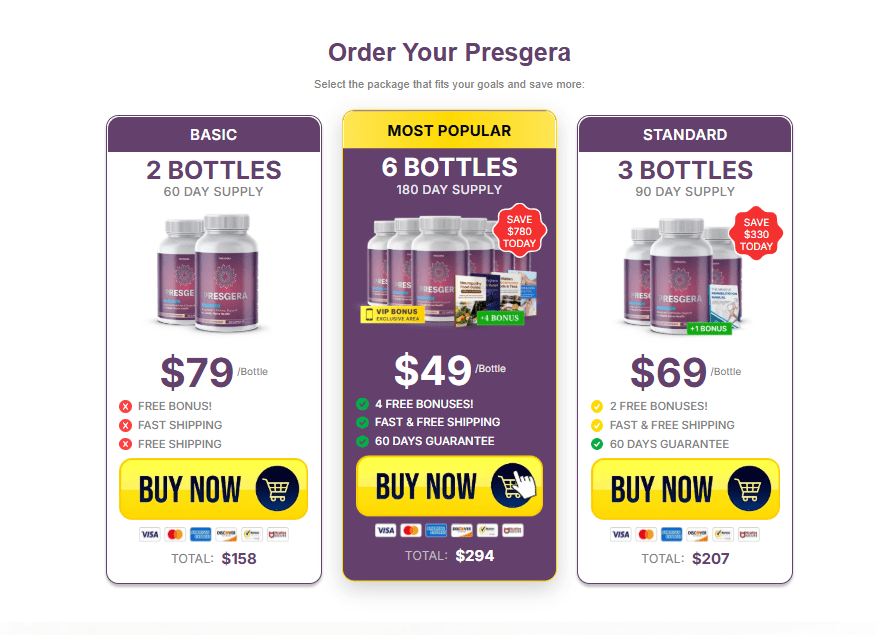
3. Overwhelming Negative Customer Feedback: Across forums and discussion platforms, users report little to no improvement in nerve pain, tingling, or numbness. Some also mention headaches, dizziness, or digestive discomfort. These reports contradict the highly positive Presgera reviews shown on official pages, suggesting review manipulation.
4. Misleading Money-Back Guarantee: Presgera marketing promotes a “risk-free” guarantee, but users attempting refunds often face unresponsive support, delays, or hidden conditions. Many report refund denials, making the policy appear more like a sales tactic than real consumer protection.

5. Unverified and Questionable Ingredients: The Presgera capsule lists common nerve-support ingredients, but exact dosages, sourcing, and purity are not clearly disclosed. Without independent lab testing, there is no proof these ingredients are present in effective or safe amounts.
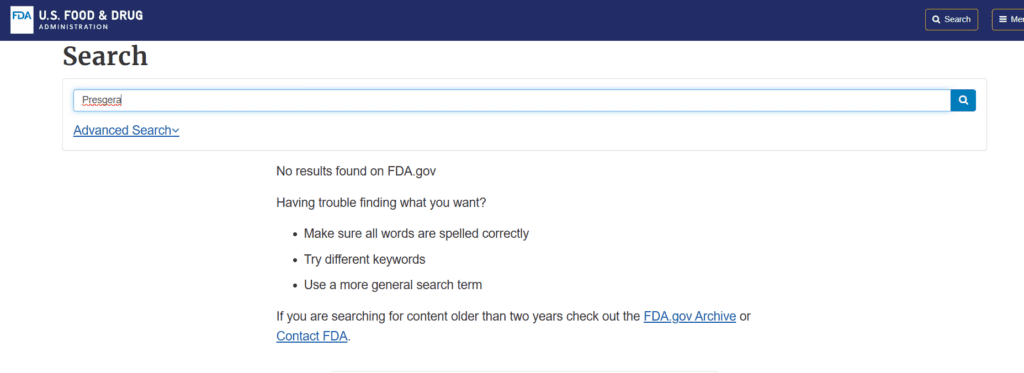
6. No Independent Testing or Clinical Evidence: There are no publicly available clinical trials or third-party lab reports confirming the effectiveness of the Presgera nerve health capsule. While supplements are not pre-approved by regulators, credible products usually provide supporting evidence.
Sources: FDA
7. Fake Endorsements and Manipulated Ratings: Promotional pages often display stock images of doctors, vague testimonials, and near-perfect ratings. Negative feedback is rarely shown, while independent sources reveal mixed or poor experiences, raising concerns about authenticity.

8. Anonymous Manufacturer and Hidden Ownership: Presgera provides no verifiable company registration, address, or leadership information. Domain ownership is often hidden, making it difficult to identify the company behind the product. This lack of transparency reduces accountability in case of disputes or issues.
Is Presgera Scam or Legit?
Presgera is a scam. It targets individuals suffering from nerve pain by promising fast relief and nerve repair without medical treatment, yet it lacks verifiable clinical evidence, transparent manufacturing, and credible testing. The product is sold through aggressive marketing funnels using exaggerated claims, questionable endorsements, and curated positive reviews to create false trust. Many users report little to no improvement in symptoms, while some experience side effects such as headaches, dizziness, or digestive discomfort.
What Presgera Lacks vs. What a Legit Health Supplement Should Have
The differences between Presgera nerve health supplement marketing and a legitimate, science-backed health supplement are significant. Our investigation found multiple transparency and credibility gaps that raise serious concerns about the product’s reliability, effectiveness, and safety for consumers.
| Presgera | A Legit Health Supplement |
|---|---|
| No verified manufacturer or transparent company details | Publicly registered company with verifiable ownership and clear contact information |
| Uses exaggerated nerve repair and pain relief claims | Supported by qualified medical professionals with realistic health claims |
| No independent clinical trials or third-party lab testing | Backed by peer-reviewed research and verified laboratory testing |
| Promises fast nerve recovery without medical treatment | Makes evidence-based claims about gradual and medically guided improvement |
| Reviews mostly appear on promotional or seller-controlled pages | Authentic reviews available across independent consumer platforms |
| Sold through aggressive, urgency-driven websites with unclear policies | Sold by identifiable brands with transparent pricing, support, and refund policies |
Presgera Complaints and Reviews
Presgera reviews from independent-style forums and discussion platforms suggest that many users experience little to no relief from nerve pain or related symptoms. Common complaints include lack of effectiveness, headaches, dizziness, stomach discomfort, and frustration with customer support or refund delays. These patterns indicate that the Presgera Scam relies more on marketing promises than real user results.
Ethan Walker, United States, Ohio (Age 38, Male)
Source: Reddit

Maya Patel, Canada, Toronto (Age 34, Female)
Source: Trustpilot
used presgera capsule for few weeks and started getting bloating and stomach discomfort along with no improvement in my symptoms really disappointed with this product

Lucas Hernandez, United States, Texas (Age 42, Male)
Source: Quora
thought presgera nerve health supplement would help my neuropathy after seeing ads but nothing changed even after full course still same pain no improvement just another overhyped supplement
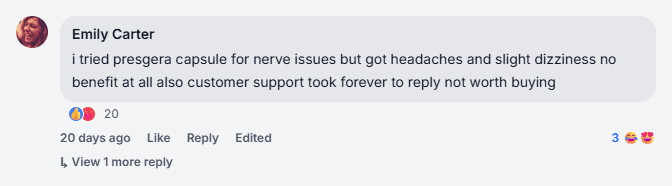
Emily Carter, United Kingdom, London (Age 36, Female)
Source: Facebook
Ryan Mitchell, Australia, Sydney (Age 40, Male)
Source: Trustpilot
very disappointing product expected at least some nerve relief but nothing happened just wasted money and time support was slow and not helpful would not recommend presgera at all
Presgera Ingredients: Inside the Product
Presgera ingredients are marketed as nerve-supporting vitamins and herbal compounds, but there is no independent verification of dosage, sourcing, or third-party testing confirming their safety or effectiveness. The formula appears to rely more on marketing claims than transparent scientific validation for the Presgera nerve health supplement.
- Alpha Lipoic Acid: Promoted to support nerve repair and reduce oxidative stress, but the exact dosage and effectiveness within the Presgera capsule are not clearly disclosed or independently verified.
- Vitamin B Complex: Marketed to support nerve function and reduce neuropathy symptoms, yet the specific amounts and absorption levels in the Presgera nerve health capsule remain unclear.
- Magnesium: Claimed to help with nerve signaling and muscle relaxation, but there is no confirmation of its concentration or whether it contributes meaningfully to results.
- Herbal Extracts: Often included for nerve support and circulation benefits, but the formula does not disclose sourcing, purity, or standardized dosages.
- Other Compounds: Additional ingredients may be listed, but without transparent labeling or third-party testing, their presence, quality, and effectiveness in the presgera supplement cannot be confirmed.

Presgera Ratings
The ratings associated with Presgera nerve health supplement marketing appear inconsistent and potentially misleading. Promotional websites display very high ratings, while independent-style consumer discussions often show skepticism and negative experiences from users.
| Website | Ratings | Reliability |
|---|---|---|
| Trustpilot | 1.8 / 5 | Reliable. Users report little to no nerve relief, headaches, stomach discomfort, and refund issues. |
| N/A | Reliable. Discussions often question the effectiveness of the Presgera supplement and its marketing tactics. | |
| Quora | N/A | Reliable. Users express doubts about Presgera capsule claims and the lack of scientific proof. |
| BBB | Unrated | Reliable. No verified business profile and limited accountability information were found. |
| Official Website | 4.8 / 5 | Questionable. Reviews appear curated, with very few visible negative comments about the Presgera nerve health capsule. |
Presgera Scam Risk Score
Presgera nerve health supplement was evaluated across five key risk categories to measure overall consumer risk and product credibility. The findings indicate a very high risk level due to poor transparency, unverified health claims, and repeated customer complaints.
| Metric | Risk Score (0–10) | How We Rated It |
|---|---|---|
| Unverified Claims | 10/10 | Promises nerve repair, pain relief, and circulation support without credible clinical evidence |
| Ingredient Transparency | 9/10 | Exact dosages, ingredient sourcing, and third-party lab verification are not publicly disclosed |
| Customer Complaints | 9/10 | Users report little to no symptom relief, headaches, stomach discomfort, and refund difficulties |
| Manufacturer Transparency | 10/10 | No clearly verifiable company identity or traceable production facility |
| Marketing Honesty | 9/10 | Relies on exaggerated nerve health claims and potentially misleading testimonials |
| Overall Scam Risk Score | 9.3 / 10 | Extremely High Risk |
Fake Presgera Websites
Multiple suspicious websites promote Presgera using urgency tactics and “limited stock” warnings that redirect buyers to anonymous checkout pages with vague refund terms and no clearly verified company details.
| Website URL Types | Warning Signs / Notes |
|---|---|
| Fake “News” Articles | Designed to look like independent health reports but function as paid advertorials that redirect readers to Presgera sales funnels |
| Affiliate “Review” Blogs | Overly positive and repetitive content written mainly to earn commissions rather than provide balanced analysis of the Presgera supplement |
| “Official” Sales Pages | Use countdown timers, large discount banners, and urgency tactics while providing no clearly verified manufacturer details |
| Social Media Ad Links | Redirect users to cloned checkout pages with hidden domain ownership and unclear billing conditions |
How We Investigated Presgera
Our investigation into Presgera nerve health supplement claims followed a structured, evidence-based approach to identify misleading marketing practices and evaluate real consumer experiences. The process included the following steps:
Analyzing Customer Complaints: We reviewed reports from independent-style platforms such as Reddit, Trustpilot, Quora, and consumer discussion forums. Many users reported little to no nerve relief, no meaningful improvement in tingling or numbness, headaches, dizziness, stomach discomfort, and difficulty obtaining refunds or customer support.
Scrutinizing Marketing Tactics: We analyzed promotional campaigns featuring dramatic nerve repair claims, “limited-time” discounts, countdown timers, and strong promises of relief without medical treatment. These claims appeared far more aggressive than the evidence available for the Presgera capsule.
Investigating the Company: Using domain lookup and verification methods, we searched for manufacturer information and company registration details. Verified ownership, corporate registration, and traceable contact information were largely unclear or unavailable for the Presgera supplement.
Verifying Claims vs. Evidence: Nerve health and pain relief claims were compared with established medical understanding and available supplement research. No published clinical studies specific to Presgera nerve health supplement were found to support the marketing promises.
Checking for Consumer Alerts: We examined complaint boards, scam discussions, and consumer warnings. Repeated concerns about ineffective results, marketing exaggerations, and refund problems raised major credibility concerns and strengthened the case for Presgera Scam warnings.
How to Identify Scam Supplements Like Presgera
To avoid falling for deceptive products like the Presgera supplement, watch for these warning signs:
Promises of “Miracle” Nerve Repair: Legitimate nerve health products do not guarantee instant pain relief, rapid nerve regeneration, or complete recovery without medical support. Be cautious of Presgera capsule claims that sound too fast or unrealistic.
Anonymous or Hidden Company: Avoid products that do not provide a verifiable company name, physical address, or clear contact details. Presgera Scam concerns increase when ownership and accountability are unclear.
No Third-Party Testing: Reliable supplements offer independent lab testing to confirm ingredient purity, dosage accuracy, and safety. If the Presgera nerve health supplement lacks verifiable testing, it is a major red flag.
Fake Reviews and Pressure Tactics: Countdown timers, “limited stock” alerts, and overly positive testimonials are common warning signs. Always verify Presgera reviews on neutral platforms rather than relying on seller-controlled pages.
Hidden Subscription Traps: Some sellers use recurring billing with unclear cancellation policies. If purchasing Presgera involves confusing checkout terms, it may lead to unexpected charges.
Presgera Side Effects
Presgera contains ingredients with unclear dosage transparency and no verified third-party testing, making potential side effects unpredictable and raising safety concerns:
- headaches dizziness or lightheadedness reported by some users
- nausea or stomach discomfort after taking the presgera capsule
- digestive irritation or mild cramps in sensitive individuals
- fatigue or unusual tiredness in some cases
- possible allergic reactions to herbal or vitamin components
- worsening discomfort in individuals with preexisting nerve conditions
Presgera Refund Process
Do not rely solely on Presgera customer support for refunds, as many buyers report delayed responses or difficulty recovering their payments. To improve your chances of getting your money back:
- Contact your bank or credit card provider immediately and report the transaction as potentially misleading or fraudulent.
- Gather proof of purchase, including order confirmation emails, payment receipts, website URLs, and screenshots of Presgera supplement claims.
- Request a chargeback explaining deceptive marketing, unclear refund terms, or failure of the Presgera capsule to deliver promised results.
- Submit complaints to consumer protection agencies to formally document the issue and increase pressure on the seller.
- Ask your bank to block future charges from the merchant to prevent unauthorized recurring billing, which is common with such products.
Expert-Reviewed & Customer-Approved


Final Verdict: Is Presgera Worth It?
No, Presgera is not worth it. The product lacks verified clinical evidence, transparent manufacturer information, and independent testing to support its nerve health claims. Many users report little to no symptom relief and occasional side effects, while refund processes appear unreliable. Buying Presgera may expose consumers to financial risk and uncertain product quality. For safer nerve health support, choose reputable brands with verified testing and transparent ingredient disclosure.
Frequently Asked Questions (FAQ)
How do I know if Presgera is real?
Legitimate health supplements are sold by transparent companies with verifiable business information, clear contact details, and credible scientific backing. If Presgera is mainly promoted through aggressive ads or anonymous websites with limited company transparency, consumers should proceed with caution.
What are the side effects of Presgera?
Some users report headaches, dizziness, stomach discomfort, or digestive issues. Because ingredient dosages and independent safety testing are not clearly disclosed, individual reactions may vary depending on sensitivity to the ingredients used in the Presgera capsule.
Is Presgera safe to use?
Safety cannot be fully confirmed due to limited transparency about ingredient sourcing, dosage levels, and third-party testing. Individuals with existing medical conditions or those taking medications should consult a healthcare professional before using the Presgera supplement.
Has anyone used Presgera? What were the results?
Consumer discussions on independent forums frequently report minimal or no noticeable improvement in nerve pain or discomfort. Some users mention side effects or dissatisfaction, which contrasts with the highly positive Presgera reviews shown on promotional websites.
Is Presgera approved by the FDA?
No. Presgera is not FDA approved. Dietary supplements are not evaluated by the FDA for effectiveness before being marketed, meaning claims about nerve repair or pain relief are not officially validated.
Where can I buy the real Presgera?
The Presgera supplement is generally sold through online sales pages rather than trusted retail platforms. Buyers should be cautious of unfamiliar websites that lack clear company information, transparent refund policies, or verified customer support.
Are there fake Presgera websites?
Yes. Some websites mimic legitimate product pages using countdown timers, bold health claims, and heavy discounts. These sites may frequently change domains, making it difficult to verify authenticity or request refunds.
Does Presgera really work for nerve health?
There is no publicly available peer-reviewed research confirming that Presgera nerve health supplement delivers reliable or consistent results. Managing nerve conditions typically requires medical guidance and evidence-based treatment.
Who makes Presgera?
Clear manufacturer details are difficult to verify. Limited transparency about the company behind Presgera raises concerns about accountability, product quality control, and customer service reliability.
How can I avoid Presgera scams online?
Avoid urgency-driven sales pages, exaggerated health claims, and websites with no verifiable company details. Choose supplements from reputable brands that provide third-party testing, clinical support, and independent customer reviews.
Are there real customer reviews for Presgera?
Independent platforms show mixed to negative user experiences, while promotional pages display mostly positive testimonials. This imbalance suggests that some Presgera reviews may be selectively presented or manipulated.
Sources
- World Health Organization, 2006. Neurological disorders: public health challenges. World Health Organization. Available at: https://books.google.com.np/books?hl=en&lr=&id=Z8uwPwlPUw4C&oi=fnd&pg=PP1&dq=Nerve+health&ots=gipIC4ZARm&sig=MXW80o5ynWcY–oIXGrx5VLpSZs&redir_esc=y#v=onepage&q=Nerve health&f=false
- de Groat, W.C. and Yoshimura, N., 2009. Afferent nerve regulation of bladder function in health and disease. Sensory nerves, pp.91-138. Available at: https://link.springer.com/chapter/10.1007/978-3-540-79090-7_4
- MacDermid, J.C., 2005. Measurement of health outcomes following tendon and nerve repair. Journal of Hand Therapy, 18(2), pp.297-312. Available at: https://www.sciencedirect.com/science/article/abs/pii/S0894113005000499
- Lopes, B., Sousa, P., Alvites, R., Branquinho, M., Sousa, A.C., Mendonça, C., Atayde, L.M., Luís, A.L., Varejão, A.S. and Maurício, A.C., 2022. Peripheral nerve injury treatments and advances: one health perspective. International journal of molecular sciences, 23(2), p.918. Available at: https://www.mdpi.com/1422-0067/23/2/918
- Walsh, M.E., Sloane, L.B., Fischer, K.E., Austad, S.N., Richardson, A. and Van Remmen, H., 2015. Use of nerve conduction velocity to assess peripheral nerve health in aging mice. Journals of Gerontology Series A: Biomedical Sciences and Medical Sciences, 70(11), pp.1312-1319. Available at: https://academic.oup.com/biomedgerontology/article-abstract/70/11/1312/2605545

Dr. Elizabeth Morgan is a gastroenterologist and clinical researcher specializing in digestive health and liver function. She earned her Ph.D. in Nutritional Science from the University of California, Davis, and completed her residency at Johns Hopkins Hospital. Dr. Morgan has worked as a Clinical Research Scientist in gastroenterology, investigating how supplements affect digestion, gut health, and nutrient absorption. Her work emphasizes consumer education on the dangers of untested digestive health products and fraudulent “detox” supplements.